Last verified February 2026.
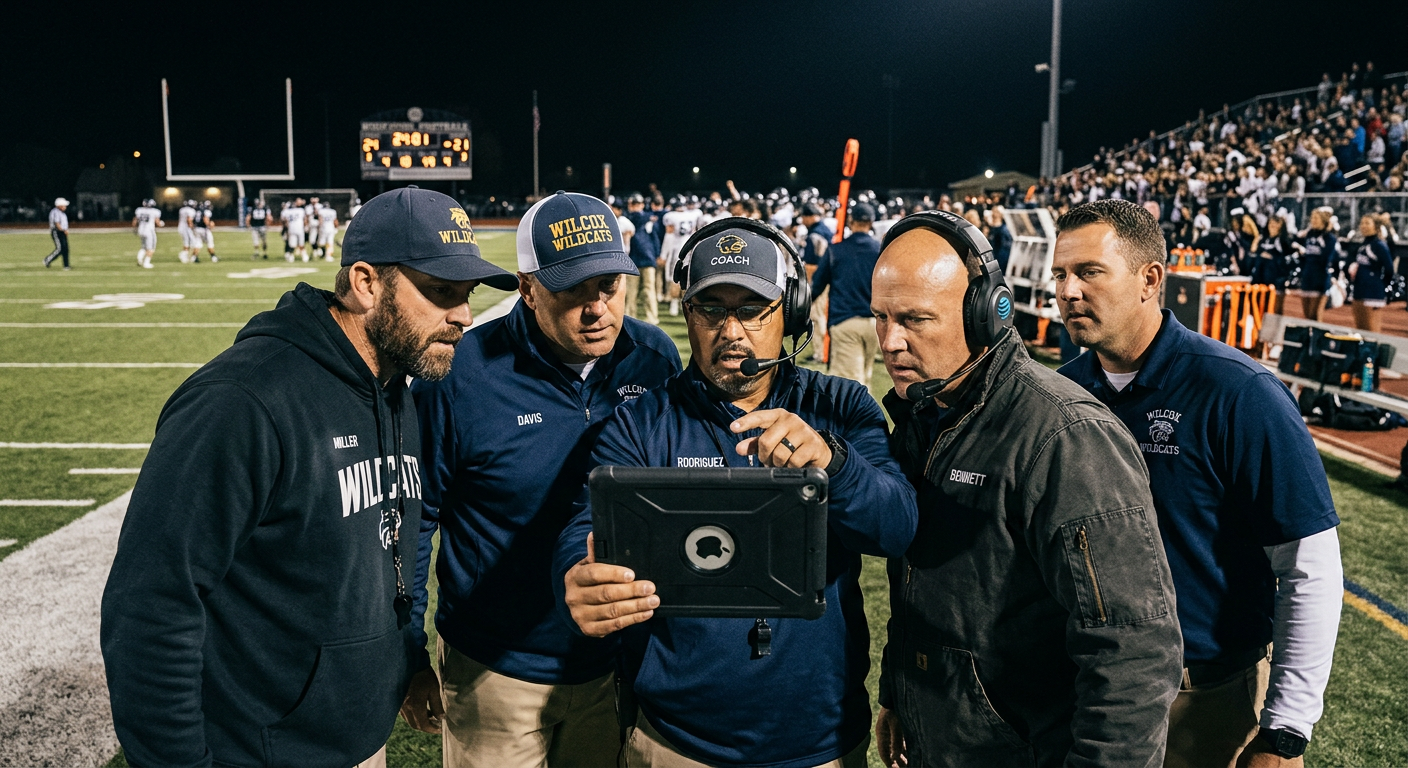
If you coach high school football and you have started looking at technology past Hudl, you have probably run into Modern Football. They are one of the more visible names in football analytics right now, and for good reason. Their customer list includes Mater Dei, St. John Bosco, Lake Travis, Bishop Gorman, Folsom, Arizona State, Boise State, Cal, and the Miami Dolphins.
That is not a list you build by accident.
So if you are searching for a Modern Football alternative, or you are trying to figure out where SpiralXO fits next to them, this is the honest version. Both are solid products. Both tag plays live and turn every snap into real-time tendencies. The difference is what sits around that in-game engine.
SpiralXO is already run by high school and college programs across the country. It does the same in-game work Modern Football does. What it adds is the rest of your week: the playbook, the installs, the quizzes, the practice script, the scout, and the call sheet, all connected to the same play data.
The Short Answer
A Modern Football alternative like SpiralXO does the same in-game work, live play tagging and real-time tendencies, but connects it to your entire program. Modern Football is a specialist data layer that sits on top of your existing stack. SpiralXO is the system your playbook, practice, scouting, call sheet, and live tagging all run on. One is a layer. One is the system.
What Modern Football Is Built To Do
Modern Football calls itself the Football Intelligence Platform, and their focus is narrow on purpose. The whole product is organized around capturing football data fast enough to use it while the game is still going.
Here is what they publicly market:
Real-time tagging. A coach taps plays into a tablet as the game happens. Touchscreen input, no typing. You can enter full play calls, single-word calls, or wristband numbers.
Live self-scout and opponent tendencies. Instead of waiting for halftime to figure out what is working, the staff sees efficiency by concept, personnel, and situation while the game is live. Their pitch is built around the 5 to 15 seconds between snaps.
Sideline reports. They connect the booth and the sideline so the guy calling plays sees the same data the guy in the box is looking at.
Automated charting and exports. They eliminate a lot of manual entry by pushing data out to Hudl, MaxPreps, DVSport, Catapult, and PFF. They publicly claim this saves staffs 20 to 30 hours a week.
Configurable data model. Programs can define what they want tracked without needing an engineer. If you count explosives differently than the next guy, you can set that up your way.
Their pricing is not published. You book a demo and get a quote.
Here is the part worth saying plainly: at pure in-game analytics, Modern Football is very good. They have been at this since 2022, the founders came out of the University of Texas staff, and they are running in NFL and Power 4 buildings. As a dedicated in-game specialist with a deep integration list, they have earned their reputation.
What SpiralXO Is Built To Do
SpiralXO started from a different question. Not "how do we get better data on Friday," but "why does one program need six disconnected tools to run one system?" It is built for that, and today it runs in high school and college programs across the country.
Most staffs are running some version of this: playbook and film in Hudl or scattered across PDFs, practice structure and scripts in one Google Sheet, call sheet in another, scout reports in a Word doc, player quizzes in a different tool, team communication in a group text, and a half-dozen logins nobody remembers.
SpiralXO puts all of it in one place:
Playbook and installs. A playbook builder with saved formations, defenses, routes, and blocking schemes. Plays animate. Player responsibilities generate automatically. You attach teach tape, assign installs, and see who has actually completed them.
Player accounts. Every player gets a login. They review the playbook on the bus, take auto-generated quizzes, see the practice script, and read the scout report you want them to see.
Practice planning. Build plans, save templates, and generate scripts through the practice planner.
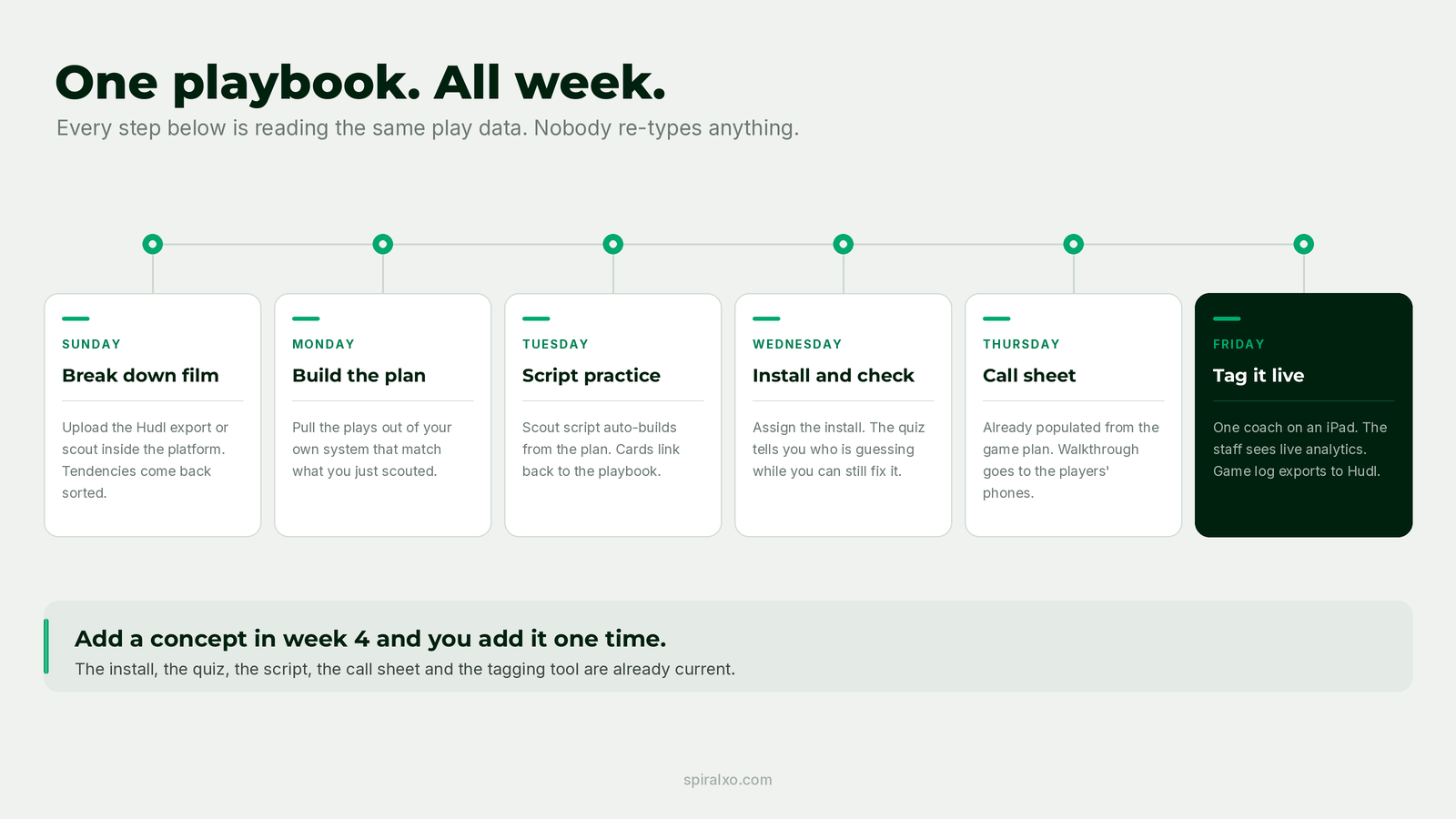
Game Focus. Four connected pieces. Scout your opponent inside the platform or upload the Excel you already pulled from Hudl and let it break down for you. Pull plays from your own system that match up against what you scouted. Auto-build the scout practice script from your game plan, with scout cards linked from your playbook. Then tag it live.
Live tagging. One coach inputs on an iPad. The rest of the staff sees live analytics. Exports to a game log that goes to Hudl or QwikCut.
Program operations. Roster, depth charts, events, attendance, staff task lists, team drive, and Discord-style communication channels instead of a group text.
The Silo Problem
This is the part that matters most, and it is the reason a lot of staffs end up looking for a Modern Football alternative even when they like the product.
Modern Football is designed to sit on top of your existing stack. Their own material describes the platform as the front-end data collection layer that feeds your video share and analytics tools. They are explicit that they enhance the video system you already have. That is a legitimate design choice. If what you want is a specialist data layer bolted onto tools you already run, it is a clean way to get one.
But think about what that means for any staff on a Tuesday.
Your play universe has to be defined inside the tagging tool so it can chart against it. Your playbook lives somewhere else. Your install notes live somewhere else. Your practice script lives somewhere else. Your scout report lives somewhere else.
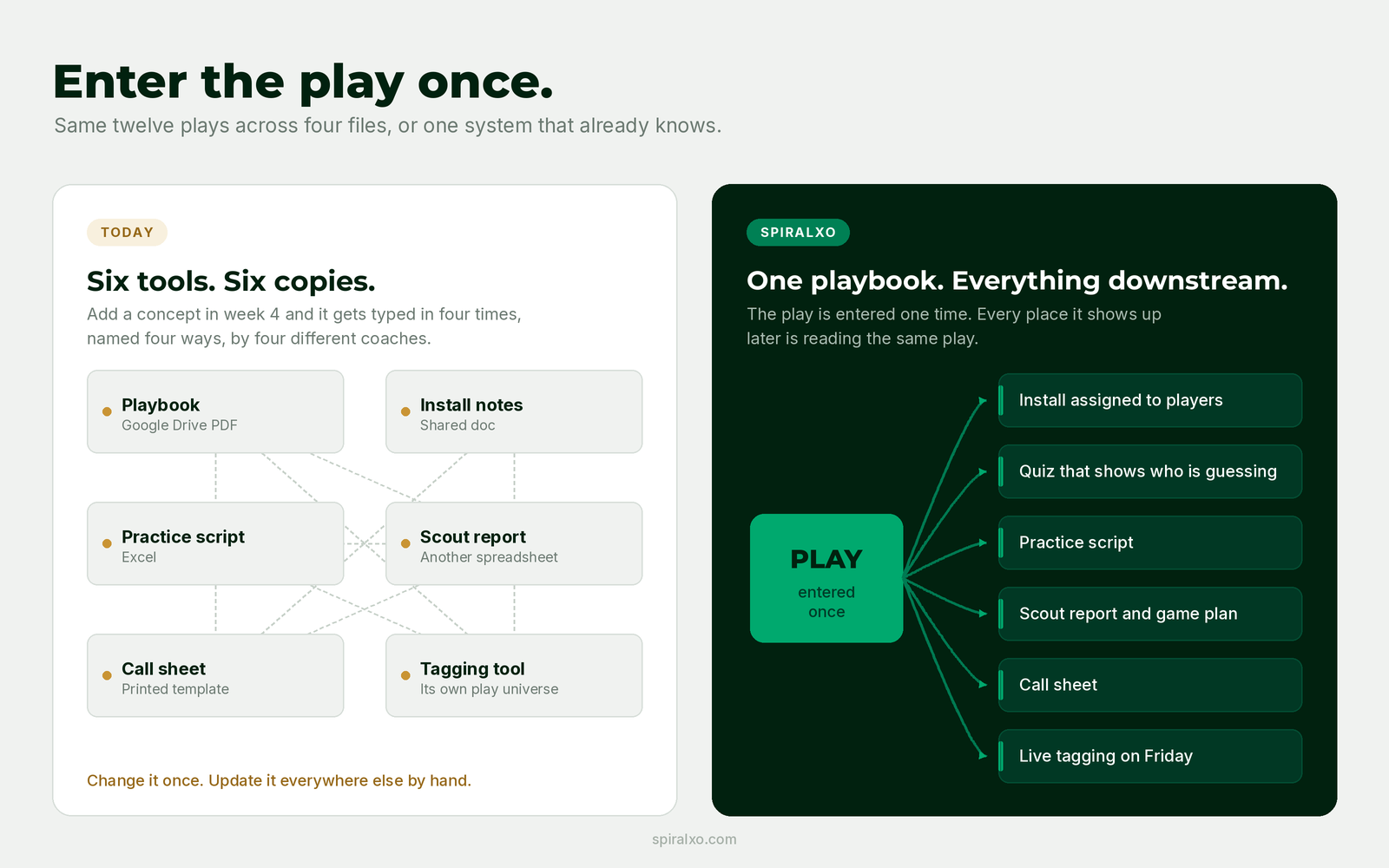
When you add a concept in week 4, you add it in the tagging tool. Then you add it to the playbook PDF. Then you add it to the install doc. Then it shows up on the script. Same play, four entries, four chances for it to be named slightly differently by four different coaches.
When you tweak your call sheet before a playoff game, that change does not walk itself back into anything else. The tagging tool knows about the change. Your players do not.
In SpiralXO, the system already knows the play.
You build it in the playbook. From there it is the install your players are assigned, the quiz that tells you whether the sophomore guard actually knows his rule, the practice script, the game plan against what you scouted, and the call sheet. And when you tag it live on Friday, the platform already knows what that play is, because it is the same play.
Change the play once and it changes everywhere. The same concept, the same numbering, the same rules, all the way through the week. No re-typing, no reconciling names, no wondering if the script matches what the call sheet says.
That is the difference. It is not that one product tags better. It is that in one of them, the in-game data lives inside the same system that runs the rest of your week, and in the other, it is a well-built room with its own door.
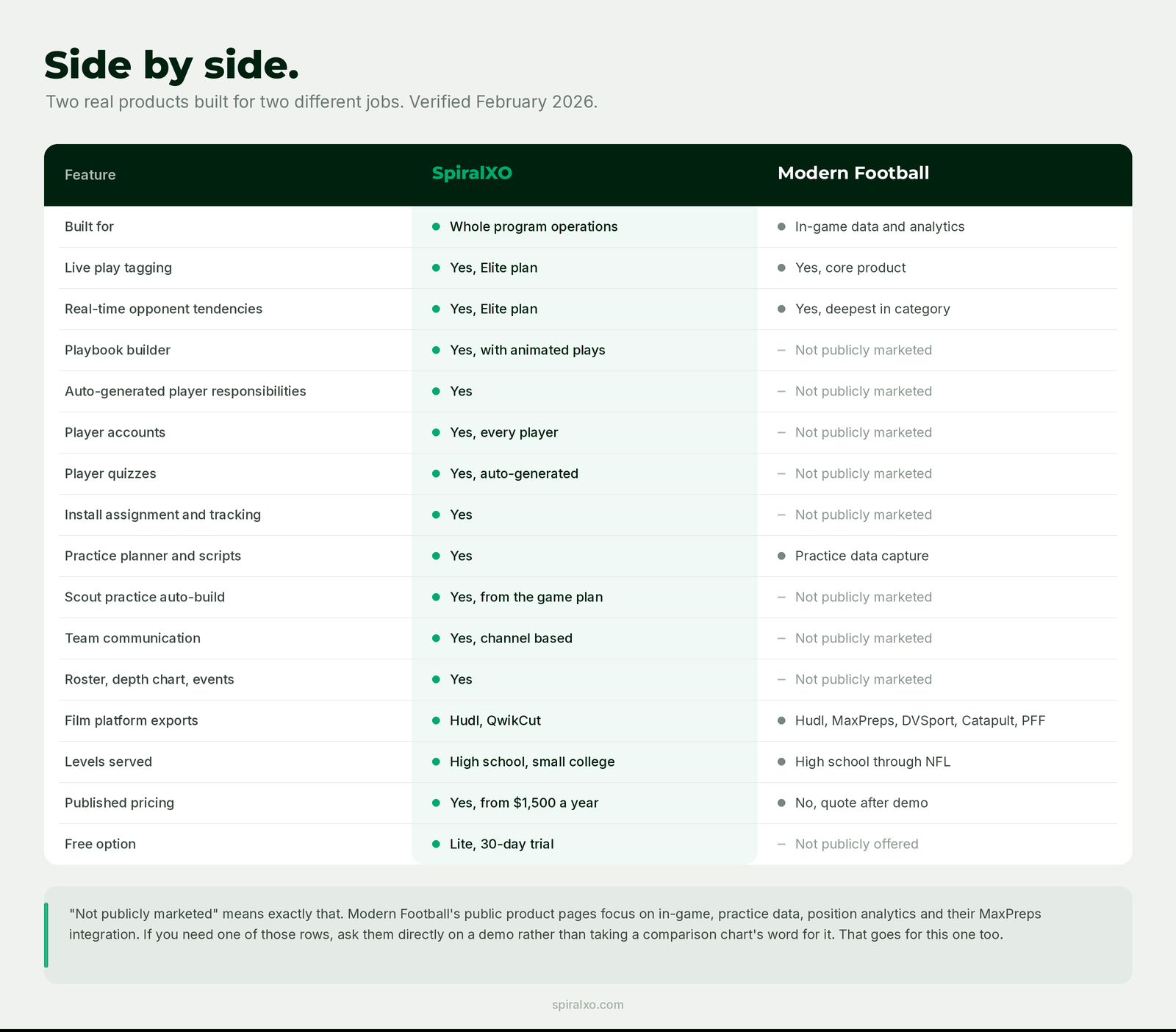
Feature Comparison
Where Modern Football Is The Right Call
There are programs that should pick Modern Football, and it is worth being specific about which ones.
You want a specialist, not a system. If your playbook, practice, and player development already live in tools you are happy with, and the only thing you want to add is a dedicated in-game data layer, that is exactly what Modern Football is. It does one job and does not ask you to move anything else.
You are committed to a specific analytics stack. Their integration list is longer than ours. If your building runs Catapult or PFF or DVSport and you want your in-game data flowing straight into those, that is a genuine advantage.
You are buying the seconds between snaps. Their entire product is organized around that window, and they have spent four years sharpening it. If in-game capture is the specific thing you are shopping for, they are a focused, credible choice.
Your stack is deliberately best-of-breed. Some staffs would rather run the best standalone tool in each category and wire them together themselves. If that is your philosophy, a dedicated data layer fits it.
Here is the honest read on that list. Every one of those is a real reason, and none of them is about a program being too big or too small. It is about whether you want a specialist layer that plugs into your stack, or one system that runs the whole thing. If it is the former, Modern Football is a strong pick.
Where SpiralXO Is The Right Call

Which brings us to what SpiralXO is actually built to do.
You want the in-game data and the system it connects to. SpiralXO tags plays live and shows your staff real-time tendencies, the same in-game work a dedicated tool does. The difference is that the play you tag on Friday is already known to the playbook, the install, the quiz, the script, the scout, and the call sheet. One system, all week.
You are tired of disconnected files. The same concept lives in the playbook, the install, the script, the scout, and the call sheet. When any of them change, the question is whether the rest of the staff knows about it. In a connected system, they do.
You want mental errors to show up before Friday. A playbook players can actually get to, quizzes that tell you who is guessing before game day, and install tracking that shows you where the gap is. In-game data tells you what happened. This tells you who is ready before it does.
You want your prep time back. Scouting, game plan, scout script, and scout cards in one connected flow instead of four disconnected files.
You need it to survive a staff change. When a coordinator leaves and everything lived in his Drive folder, it leaves with him. When it lives in the program's platform, it stays.
You want pricing you can actually see. SpiralXO publishes it. Plans start at $1,500 a year, which includes two teams at no extra cost, and Elite starts at $2,000 with four teams and live analytics. Final pricing depends on program size. There is also SpiralXO Lite at $29 a month or $299 a year with a 30-day free trial, so you can put hands on it before anybody signs anything.
Can You Run Both?
Yes, and some programs will want to.
If your staff is already deep into Modern Football for in-game work and it is doing the job, you do not have to rip it out. SpiralXO's playbook, install, quiz, practice, and communication side solves problems Modern Football is not trying to solve. Running SpiralXO Pro alongside a dedicated analytics tool is a real setup.
The question is whether you want to carry two subscriptions and keep the play data matched by hand across both. Every concept you add has to go in twice, named the same way both times, or the reports stop lining up.
Either way, someone owns that reconciliation, and it is duplicate work by definition. Most programs that try it end up consolidating within a season.
But it is your call sheet, not ours.
The Bottom Line
Modern Football built an excellent tool for one part of the week. Friday night, between the snaps, with a staff that knows exactly what to do with a number the second it shows up. They have earned every bit of the reputation they have.
The question is whether one part of the week is the part that is actually costing you.
But it is one part of the week. The tendency you catch in the third quarter matters. So does the sophomore guard who never learned his rule, the install taught three different ways by three different coaches, and the version of the call sheet that does not match the script on Tuesday.
A standalone tagging tool captures the first one. On its own, it does not touch the rest, and it becomes one more place your plays live and one more thing to keep in sync.
SpiralXO was built the other direction. The same live tagging and real-time tendencies, feeding off one playbook that also feeds the install, the quiz, the script, the scout, and the call sheet. Change it in one place, and the whole week is already current, including your players.
If you want a specialist in-game layer to bolt onto a stack you are otherwise happy with, Modern Football is a strong pick and they will serve you well.
If you want that same in-game data connected to the entire program, from the playbook your players study to the call sheet you print Friday, that is the case for SpiralXO. It is why high school and college staffs across the country run it.
Best way to sort it out is to see it. Book a demo and bring your actual problem. If SpiralXO is not the fit for your program, we will tell you.
Frequently Asked Questions
Is SpiralXO a Modern Football alternative?
Yes. SpiralXO does the same in-game work Modern Football does, live play tagging and real-time tendencies, and connects it to your playbook, installs, quizzes, practice, and call sheet. Modern Football is a dedicated in-game specialist with a broader analytics-integration list. SpiralXO is the connected system that data lives inside.
Does SpiralXO have live play tagging like Modern Football?
Yes, on the Elite plan. One coach inputs plays on a tablet and the rest of the staff sees live analytics on what is working, and it exports to a game log that goes to Hudl or QwikCut. Modern Football is a dedicated in-game specialist and integrates with more film and analytics platforms.
What does Modern Football cost?
Modern Football does not publish pricing. You book a demo and receive a quote. SpiralXO publishes pricing starting at $1,500 a year, with final cost based on program size.
What is the main difference between SpiralXO and Modern Football?
Where the play data lives. Modern Football is built as a data capture layer that works alongside your existing playbook, film, and practice tools. In SpiralXO, the playbook is part of the same system that runs installs, quizzes, practice scripts, scouting, the call sheet, and live tagging.
Can a program use both SpiralXO and Modern Football?
Yes. They overlap on in-game tagging, but SpiralXO also runs your playbook, installs, quizzes, practice, and communication. Nothing prevents running both. The tradeoff is two subscriptions and keeping your play data consistent across both systems by hand.
Do players get their own accounts in SpiralXO?
Yes. Every player gets a login to review the playbook, take auto-generated quizzes, see practice scripts and scouting information, access the team drive, and use team communication channels. Player accounts on the full platform are for grade 9 and up.
How long does SpiralXO take to set up?
Most programs are live in under two weeks with about three hours of coach time. Roster setup and configuration are handled during week one.